
When you buy a new home in Vancouver, the price on the contract is only part of what you pay at closing. Two taxes come with a new home in BC: the provincial property transfer tax and the federal GST. Both have programs that can reduce them, and the rules depend on who you are, what the home is worth and how you plan to use it. This post walks you through each tax, the exemptions and rebates for new homes and first-time buyers, what changes when you build a multiplex on your own lot, and the tax on selling a home within two years.
Every rate and limit below comes from the Province of BC and Canada Revenue Agency (CRA) pages we read on October 2, 2026, with the date each page was last updated. Tax rules change with each budget. Your lawyer or notary files the property transfer tax return, and an accountant can tell you how the GST rules apply to your case. Use this post to prepare your questions for them.
Two Taxes, Two Governments
Property transfer tax is a BC tax. The Province's property transfer tax page (last updated December 3, 2025) says you pay it when you buy or gain an interest in property registered at the Land Title Office, unless you qualify for an exemption. It is based on the fair market value of the land and the building on the day of registration. In most cases a lawyer or notary completes the filing for you.
GST is a federal tax. A builder who sells a new home charges it on the sale. The CRA's rate table lists British Columbia at 5% GST.
The two taxes have separate forms, separate offices and separate rules. Qualifying for one program tells you nothing about the other, so check each one on its own.
Property Transfer Tax Rates in BC
The Province's page lists three parts of the tax. The general rate applies to every taxable purchase:
- 1% of the fair market value up to and including $200,000
- 2% of the fair market value above $200,000 and up to and including $2,000,000
- 3% of the fair market value above $2,000,000
A further 2% applies to the residential value above $3,000,000. The third part, the additional tax for foreign buyers, has its own section below.
To see what this means, the Province's own exemption table shows $20,000 of property transfer tax on a fair market value of $1,100,000, before any exemption. The Province also has an online calculator linked from the same page.
For a home bought before it is finished, the rule is different. The pre-sold strata unit page (last updated May 5, 2026) says that when you sign a written agreement before the developer deposits the strata plan, you generally pay the tax on the total amount you paid, including upgrades and any assignment premium. The Province says this gives you more certainty about the tax and about whether you qualify for an exemption.
The Newly Built Home Exemption
This is the exemption most buyers of a new Vancouver multiplex unit will ask about. The Province's page (last updated January 6, 2026) says that since April 1, 2024 the full exemption applies to a fair market value of $1,100,000 or less. A partial exemption applies between $1,100,000 and $1,150,000, and at $1,150,000 the exemption ends.
What Counts as Newly Built
The Province's list includes a house built on vacant land and a unit in a newly built condo building, as long as nobody has occupied it since construction. A strata home in a new multiplex is a strata unit, so ask your lawyer to confirm which line of the list your title fits. The transfer must also be the first registration of the property with a completed building.
Who Qualifies
You must be a Canadian citizen or permanent resident. The home must be in BC, used only as your principal residence, and on land of 0.5 hectares (1.24 acres) or smaller. Foreign entities and taxable trustees cannot claim it.
Keeping the Exemption
You must move in within 92 days of registration and live there as your principal residence for the rest of the first year. If you move out early, you repay part of the exemption based on the days left in that year.
How the Partial Exemption Works
The Province gives the formula: the tax, multiplied by (1,150,000 minus the fair market value), divided by 50,000. Its own table shows a home at $1,125,000, in the middle of that range: the tax is $20,500, the exemption is $10,250, and you pay $10,250. If only one of two buyers qualifies, the exemption is shared in the same proportion. The Province's example: a couple buys an $835,000 newly built home, the tax is $14,700, only one spouse qualifies, and the tax payable is $7,350.
Your lawyer claims the exemption with code 49 on the return. If you bought a vacant lot, paid the tax, and then built a home on it, the Province says you may get a refund when the land value plus the cost of the home is $1,100,000 or less, applying between the first anniversary and 18 months after registration.
The First Time Home Buyers' Program
If you have never owned a principal residence anywhere in the world, the first time home buyers' program (last updated June 20, 2025) is the second program to check. For homes registered on or after April 1, 2024:
- The full exemption applies to a fair market value of $835,000 or less.
- A partial exemption applies above $835,000 and below $860,000.
- The exemption covers the tax on the first $500,000 of the price.
The Province's exemption amounts page puts that in dollars: between $500,000 and $835,000, the exemption is $8,000.
You must be a Canadian citizen or permanent resident, and you must have lived in BC for at least a year before registration, or filed at least 2 BC income tax returns in the last 6 years. You must never have received this exemption before. The Province reviews every application and charges a penalty equal to the exemption if you falsely declare that you never owned a principal residence. The same 92-day move-in rule and one-year residence rule apply.
For a new home, compare the two programs with your lawyer. The newly built home limit of $1,100,000 is higher than the first time buyer limit of $835,000, and each program has its own conditions.
The Additional Tax for Foreign Buyers in Metro Vancouver
Vancouver is in the Metro Vancouver Regional District, one of the areas named on the Province's additional property transfer tax page (last updated June 20, 2025). A foreign national, foreign corporation or taxable trustee pays 20% on their share of the residential fair market value, on top of the general tax. A buyer taking a 70% interest pays it on 70% of the value.
Exemptions exist for a confirmed BC Provincial Nominee who uses the home as a principal residence (once only), and for some Canadian-controlled limited partnerships. If any buyer on your contract is not a Canadian citizen or permanent resident, raise this with your lawyer before you sign.
GST on a New Home in Vancouver
A builder who sells you a new home charges 5% GST. Two federal rebates can return part or all of it.
The GST/HST New Housing Rebate
The CRA's new housing rebate page (updated September 24, 2026) says the rebate is for individuals buying a new home as their own or a relation's primary place of residence. Corporations and partnerships cannot claim it.
Guide RC4028 (updated March 13, 2026) sets the limits. For a house and land bought from the same builder, the price must be less than $450,000. For an owner-built home, the rebate is 36% of the GST paid, to a maximum of $6,300, at full value up to $350,000, reduced between $350,000 and $450,000, and nothing at $450,000 or more. The guide says a builder can credit the rebate to you at closing, and if not, you have two years from the transfer of ownership to apply to the CRA yourself.
The First-Time Home Buyers' GST Rebate
This is the newer and larger program. The CRA's page (updated June 16, 2026) says applications are open and the rebate has received Royal Assent. Its rebate page gives the amounts:
- At or below $1 million: up to 100% of the GST, to a maximum of $50,000.
- Between $1 million and $1.5 million: the maximum is reduced step by step. The CRA's example is a $1.25 million home, which gets $25,000.
- At or above $1.5 million: no rebate.
When both rebates apply, the CRA says this one works as a top-up to the new housing rebate.
The CRA's eligibility page (updated June 9, 2026) says you must be at least 18 and a Canadian citizen or permanent resident. You must not have lived in a home owned by you or your spouse or common-law partner as your primary residence in the year you take ownership or the four calendar years before it. For a home bought from a builder, the purchase agreement must be signed on or after March 20, 2025 and before 2031, construction must start before 2031 and finish before 2036, and you must be the first person to live in the home after it is finished.
The date rules matter for a presale. The CRA's own example: a buyer who sold their last home in June 2022 and takes ownership of a new home in August 2026 does not qualify, because 2022 is within the four years before 2026. The same buyer taking ownership in February 2027 would qualify.
Building Your Own Multiplex: When GST Applies to You
If you already own your Vancouver lot and plan to build, the GST rules work differently. Here is what the CRA pages say, in plain words.
Building your own home. Guide RC4028 says an individual who builds, or hires someone to build, a house as their primary place of residence is generally not a "builder" for GST purposes. You pay GST on the construction you buy, and you may claim the owner-built rebate. The first-time home buyers' GST rebate also covers owner-built homes when construction begins on or after March 20, 2025, using the home's fair market value with a $1.5 million ceiling. The guide also says a contractor hired by a landowner to build on the owner's land is generally not the builder of the house.
Building homes to sell. The same guide says a builder includes a person in the business of building houses for sale, and an individual becomes a builder when the building is done in the course of a business or a venture for profit. If you plan to sell some of the homes in your multiplex, ask your accountant whether you are a builder and whether you charge GST on those sales. Our post on selling multiplex units under REDMA covers the separate disclosure rules for a sale of 5 or more strata lots.
Building homes to rent. CRA's GST/HST Memorandum 19.2.3 states the self-supply rule. A builder who rents out a newly built multiple-unit residential complex is treated as having sold and bought back the whole complex at its fair market value, generally when the first unit is first rented. The builder then owes GST on that value. Paragraph 46 says the rule does not apply to an individual builder who uses the complex primarily (more than 50%) as their own residence and claimed no input tax credits (the GST refunds a business claims on its costs). How that test applies when you live in one home and rent several others is a question for your accountant.
The rental rebate. Guide RC4231 (updated September 11, 2026) describes the purpose-built rental housing rebate: 100% of the GST paid or deemed paid, with no reduction by value. The building must have at least 4 units each with a private kitchen, bathroom and living area, at least 90% of the units must be held for long-term rent, and construction must start after September 13, 2023 and before 2031. On the provincial side, a non-strata rental building with at least 4 apartments, bought new between January 1, 2025 and December 31, 2030, can be fully exempt from property transfer tax under the purpose-built rental exemption, with a 10-year rental commitment. Our post on renting out a multiplex unit covers the tenancy law side.
Building with a partner. The new housing rebate is closed to partnerships and corporations. If you are looking at a limited partnership, as in our post on co-developing a multiplex, bring the GST question into the partnership talks from the start.
Selling Soon After You Buy: The BC Home Flipping Tax
Plans change. A family buys a new unit, then a job moves or the family grows. The BC home flipping tax (page last updated June 8, 2026) has applied since January 1, 2025 to profit from selling a BC residential property, including a presale contract, owned for less than 730 days. The rate is 20% of the net taxable income for a sale within 365 days, and it goes down over the next 365 days. At 730 days the tax no longer applies.
If you lived in the home as your primary residence and owned it for at least 365 consecutive days, you may deduct up to $20,000 from the taxable income. The Province's builders and developers page (last updated May 8, 2026) also lists exemptions for builders and developers, for demolishing a home and building a new one, and for adding a housing unit. Most of these need a home flipping tax return filed within 90 days of the sale, even when no tax is owed.
The Steps in Order
-
Check Who Is Buying. Before you sign, list every person going on title and whether each one is a Canadian citizen or permanent resident and a first-time buyer. These two facts decide most of the programs above.
-
Read the Contract for GST. Ask your lawyer whether the price includes GST, and whether the builder will credit the new housing rebate at closing.
-
Match the Dates. For the first-time home buyers' GST rebate, check the date you signed against March 20, 2025, and the closing year against the four-year residence rule.
-
File at Registration. Your lawyer or notary files the property transfer tax return and claims the exemption that fits.
-
Move In on Time. Both property transfer tax programs need you in the home within 92 days and living there for the first year.
-
Apply for Anything Not Credited. Rebates the builder did not credit go to the CRA directly, within the time limits in each guide.
Tips for Families Buying or Building New in Vancouver
Ask Your Accountant Before You Design. If you plan to rent or sell homes in your multiplex, the GST answer can change how you set up ownership. Make that choice before the first lease or sale contract is signed.
Keep Every Invoice. The CRA says to keep the original invoices for an owner-built rebate for six years, and it accepts no quotes or card slips as proof.
Confirm the Fair Market Value. Both property transfer tax programs and both GST rebates depend on value. Guide RC4028 suggests a professional appraisal when an owner-built home is close to a limit.
Plan to Stay a Year. Each program on this page that rewards living in the home expects you to stay at least the first year.
How Our Team Fits In
Costar works as a construction manager. One manager coordinates the trades, materials and inspections for the owner, as our process page explains. Tax advice comes from your lawyer and your accountant, so bring both into the plan early. Keep the records they will ask for: the contract, the invoices, the date construction started, the date the CRA would treat as substantial completion (when the home can be lived in), and the date you moved in.
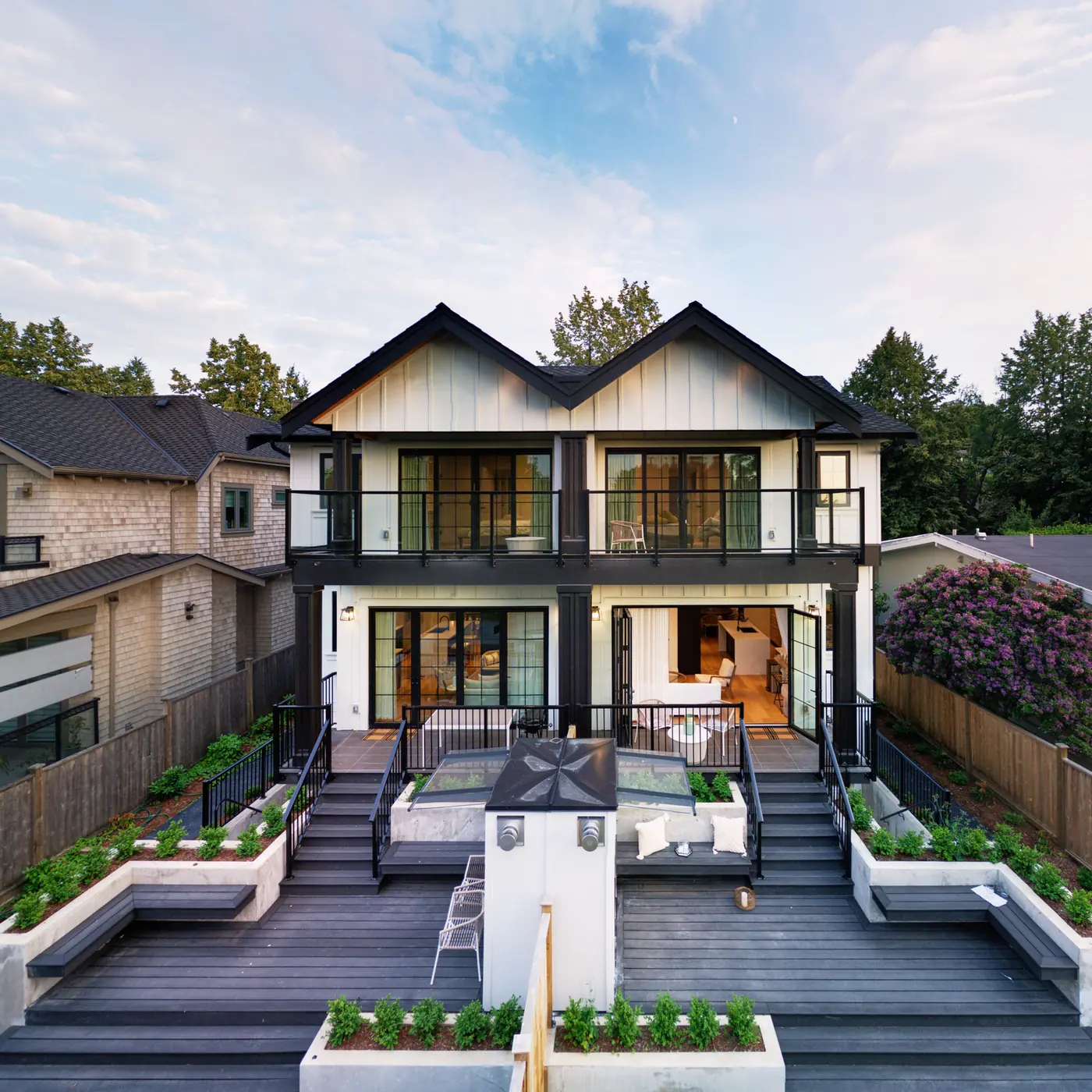
In the REW video about We Killarney, Louis Nguyen, Costar's Director of Sales, describes a multiplex as three to six units with freehold strata titles, so that several families share one lot. Our Quintet Townhomes project at 2240 E 40th Ave is a 5-plex in Vancouver. Each family that buys one of those homes meets the questions in this post at closing. See our multiplex construction and custom home pages, and the Vancouver area page, for how a project with us is set up.
We hope this helps you plan with fewer surprises. Tell us about your project today.
Related on this site: Multiplex construction in Vancouver · Book a one-hour project consultation