

If you plan to build a multiplex in Vancouver, one of the first questions is how to pay for it. For many families the money comes from a construction loan that is paid out in parts while the building goes up. How that loan works decides how much cash you need at the start, how much interest you pay during the build, and who checks the work before money moves.
In this post we walk you through how construction financing works on a multiplex, step by step, using the rules that Canada Mortgage and Housing Corporation (CMHC) and BC law publish. Then we look at the CMHC programs that apply to small buildings: the mortgage insurance for 1 to 4 units, the rental programs that start at 5 units, and the refinance for adding a suite. We finish with practical tips and a first step you can take this week. Every program figure below comes from a government page we opened on October 2, 2026. Rules and rates change, so confirm each one with your lender before you plan around it.
How a Construction Loan Pays Out
A regular mortgage pays the seller once, on the day you buy. A construction loan pays out in parts as the building goes up. CMHC calls these payments "progress advances". People in the building trade also call them draws.
CMHC's Improvement product page sets the line between the two kinds of payment. A single advance is used when the work costs 10 percent or less of the home's "as-improved" value, which is the value of the property after the work is finished. Progress advances are used for new construction, or when the work costs more than 10 percent of that value. A new multiplex falls in the second group.
The Stages Your Money Follows
CMHC's fact sheet Project Costing and the Construction Process lists the steps a building goes through: foundation, framing, roofing, windows and doors, siding, plumbing, electrical, heating and ventilation, insulation, drywall, painting, trim, flooring, cabinets and countertops. Ask your lender which of these stages it ties each advance to, and get that schedule in writing, so you know which stage releases which payment.
The same fact sheet describes how payment requests work on a larger project. The contractor sends a request for payment each month, and the architect approves it. That gives the owner a regular moment to see what was done and what it cost.
Who Checks the Work Before Money Is Released
Somebody has to confirm that a stage is finished before the lender pays for it. Under CMHC insured financing there are two options, both listed on the Improvement page:
- Full Service. CMHC itself checks and approves up to 4 advances in a row, at no cost.
- Basic Service. The lender checks the advances itself, without approval from CMHC first.
On larger rental buildings, CMHC asks for more. Its documentation checklist for the Apartment Construction Loan Program asks for a budget report from a qualified quantity surveyor. A quantity surveyor is a professional who prices construction work and tracks what has been spent. Before each advance, CMHC asks for an updated report that compares the costs spent so far with the "cost to complete", which is the money still needed to finish the building. The report also covers the schedule, the contingency budget (money set aside for surprises) and how the funds were used.
Your own lender may use an inspector, a quantity surveyor, or both. Ask who it is, who pays their fee, and how many days pass between their visit and the money arriving.
Why the Cost to Complete Matters to You
A lender wants to know that the money left in the loan, plus any money you still have to put in, is enough to finish the building. CMHC's Improvement page puts it plainly for owner-built and contract-built homes: the lender must consider the borrower's ability to cover cost overruns. It also says the insured loan and any equity in the land must be used to build and finish the project, and taking cash out of the land value is not allowed.
In plain words: if prices rise halfway through and the loan cannot cover the rest, CMHC expects you to be able to pay the difference. A contingency budget, agreed before construction starts, is the money you set aside for that case.
Interest During Construction
Interest is a real cost of building, and CMHC's project costing fact sheet lists it as part of the budget: "interest on monies borrowed during the construction period", along with the mortgage insurance premium and the lender's fee. On a loan paid out in stages, the amount you owe grows with each advance. Ask your lender how interest is charged during the build, whether you pay it each month or it is added to the loan, and when regular payments begin.
The Holdback, in Brief
BC law adds one more rule to every payment. Section 4 of the Builders Lien Act says the person who pays on a construction contract must keep back a holdback of 10 percent of the value of the work or of the payment, whichever is greater. The money protects trades and suppliers who might not be paid. Section 4(4) says that when the owner authorizes a savings institution lender to pay out the mortgage money, the lender may keep the holdback for the owner. Our guide to the holdback covers it in detail. For now, ask your lawyer and your lender who holds it on your project and when it is released.
CMHC Mortgage Insurance for 2 to 4 Units
Mortgage loan insurance protects the lender if a borrower does not repay. It lets a lender offer a larger loan with a smaller down payment. The lender pays the premium, and CMHC's consumer page says the lender will likely pass the cost on to you, either in one payment or added to the mortgage.
Building New: CMHC Improvement
CMHC Improvement is the product for "building a new home from the ground up". For homes where the owner lives in one unit, the Improvement page sets these limits:
- 1 or 2 units: insured financing up to 95 percent of the as-improved value. Minimum equity is 5 percent of the first $500,000 of lending value and 10 percent of the rest.
- 3 or 4 units: up to 90 percent of the as-improved value. Minimum equity is 10 percent.
- Value limit: the purchase price, lending value or as-improved value must be below $1,500,000 for these homeowner loans.
- Time to repay: up to 25 years. CMHC Home Start allows up to 30 years for a first-time buyer or a newly built home when the loan is more than 80 percent of the value, according to its Home Start page.
The same page lists rules for new construction that matter on a multiplex:
- CMHC must approve the financing before construction starts, or at an early stage.
- The lender must control the whole building during construction.
- No loan money is advanced on vacant land.
- The borrower must hold title to the land by the first advance, for an owner-built or contract-built home.
- A new home warranty must be in place.
- Condominium construction financing is not permitted. In BC a condominium is called a strata. If you plan to turn your multiplex into strata units and sell them, ask your lender early which financing applies.
Owner-Occupied and Rental Loans
CMHC's Purchase page says its homeowner insurance is available for 1 to 4 unit properties where at least one unit is lived in by the owner. That person can also be a family member living there rent-free, such as a parent or an adult child.
If nobody in your family will live in the building, CMHC's small rental loans apply. The Income Property page covers 2 to 4 unit rental properties that the owner does not live in, at up to 80 percent of the value, with a minimum equity of 20 percent and a value below $1,000,000.
What Your Lender Checks About You
Each of these CMHC pages lists the same tests for the borrower. At least one borrower needs a credit score of 600 or more. Your housing costs (mortgage payments, property tax and heat) can be at most 39 percent of your gross income, and all your debt payments together at most 44 percent. CMHC tests those numbers at the higher of your contract interest rate plus 2 percent, or 5.25 percent. Rent from the other units can count toward your income, and CMHC lists more than one way to calculate it.
The Premium
The premium is a share of the loan, and it rises as your down payment shrinks. On CMHC's homeowner schedule for 1 to 4 units, it is 2.80 percent of the loan when the loan is 80.01 to 85 percent of the value, and 3.10 percent at 85.01 to 90 percent. The full table is on the Improvement page.
CMHC Programs That Start at 5 Units
A five-plex or sixplex is too large for the 1 to 4 unit products above. CMHC has two programs for rental buildings of 5 units or more.
MLI Select. CMHC's MLI Select page, published September 21, 2026, says a project must have at least 5 units. Owners earn points for affordable rents, energy efficiency and accessibility, and need at least 50 points. For new construction, the page lists financing up to 95 percent of cost, and up to 40, 45 or 50 years to repay at 50, 70 or 100 points.
Apartment Construction Loan Program. CMHC lends directly through this program. The standard rental housing page says every project must have at least 5 rental units and a loan of at least $1 million. The owner must also keep rents affordable for at least 10 years under one of two options CMHC lists.
Both programs are for buildings kept as rental homes. A family that plans to sell the units, or a duplex, triplex or fourplex, needs another path.
Adding a Suite to the House You Own
If you would rather keep your Vancouver house and add a suite, CMHC has a product for that. The CMHC Refinance page lists these rules:
- You must already own the home, and you or a close relative must live in it.
- The property can have up to 4 units, counting the existing ones.
- Insured financing goes up to 90 percent of the as-improved value, and that value must be below $2,000,000.
- You can take up to 30 years to repay.
- The suite must be self-contained and must not be rented for less than 90 days in a row.
- CMHC must approve the financing before construction starts, or at an early stage.
BC's own Secondary Suite Incentive Program is closed. A Province of BC news release dated March 19, 2025 said the pilot would stop accepting applications after March 30, 2025.
When You Cannot Fund the Equity Alone
Every option above asks you to put in money first. In the REW video about Costar, Louis Nguyen, our Director of Sales, describes this situation: "In some cases, the homeowner won't be able to finance the project themselves." For those families, he describes Costar's co-development model, where the homeowner and Costar form a limited partnership. That is Costar's own account. Our post on co-developing a multiplex as a limited partnership explains what BC law says about that set-up and who carries which risk.
Practical Tips for Financing Your Multiplex
Talk to Your Lender Before Design Is Final
CMHC asks to approve insured construction financing before work starts, or at an early stage. Your unit count and your plan to live in, rent or sell each home decide which product fits. Bring those answers to your first meeting.
Ask a Mortgage Professional to Compare Options
A mortgage broker or your bank's mortgage specialist can show you which lenders offer progress advances on a multiplex, and how their schedules differ.
Get the Advance Schedule in Writing
Know which stage releases which payment, who inspects, and how long payment takes after each visit.
Budget for Interest and Fees
Add construction interest, the insurance premium and the lender's fee to your budget from the start, as CMHC's costing fact sheet lists them.
Keep a Contingency You Can Reach
CMHC asks lenders to check that you can cover cost overruns. Keep money set aside that you can use without new borrowing.
How Our Team Works With Your Lender
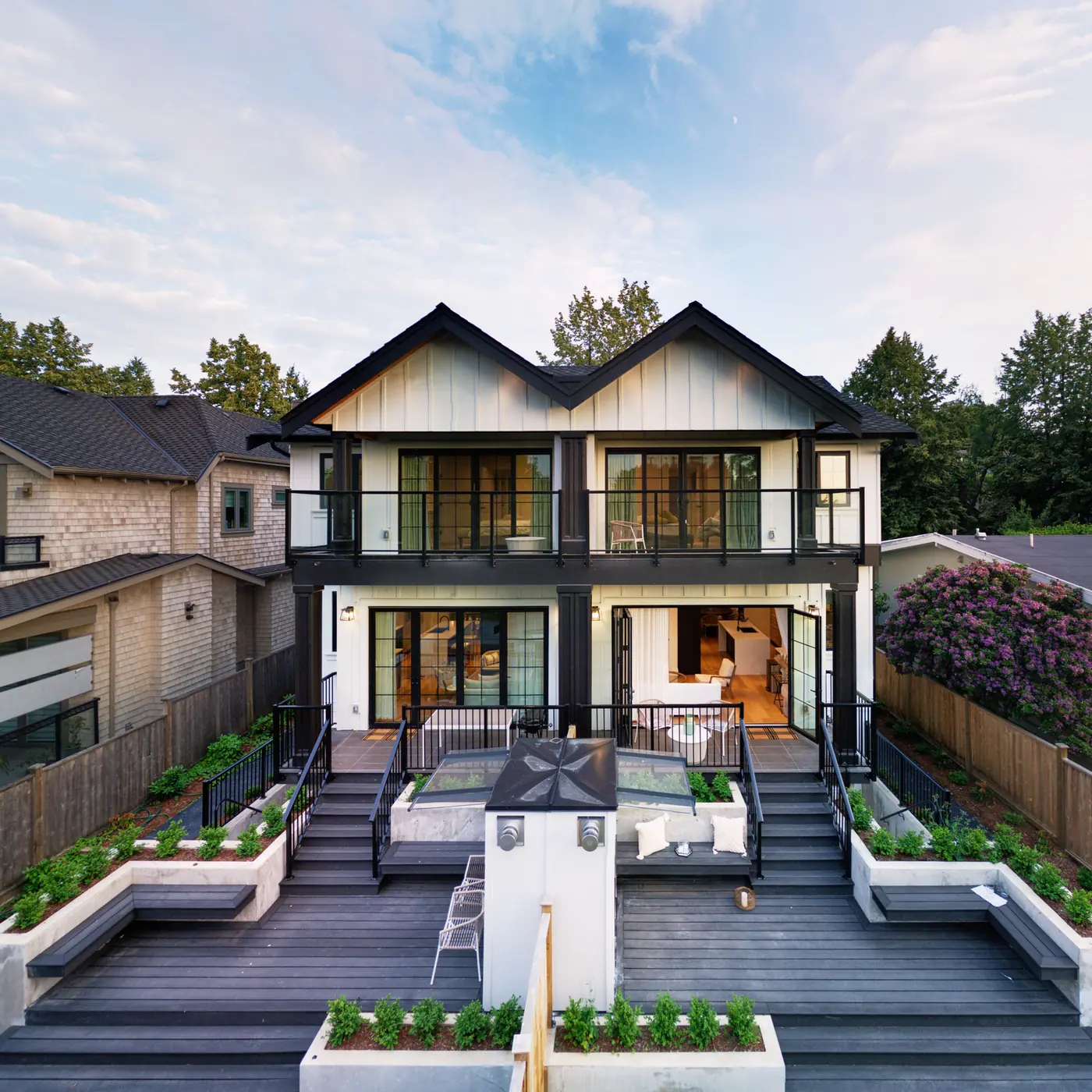
Costar's process page describes a cost-plus arrangement agreed with the client "for transparency", a written contract, and CoConstruct software "for tracking progress and expenses". With costs and progress written down for each stage, you have the papers ready when your lender's inspector or quantity surveyor asks for them. Our We Killarney Townhomes page shows a six-plex at 2333 E 54th Ave in Vancouver from our project gallery, where pre-design, permit and construction management are listed in the scope.
Before any loan talk, find out what your lot allows. Our post on multiplex zoning and permits in Vancouver and the Vancouver city page are good places to start. Then take your plan to your lender and a mortgage professional, because only they can tell you what you qualify for.
If you would like to walk through the stages of a multiplex build and how the money moves at each one, our team is happy to sit down with you before your lender meeting. Tell us about your project today.
Related on this site: Multiplex construction in Vancouver · How much a multiplex costs to build in Vancouver · Book a one-hour project consultation