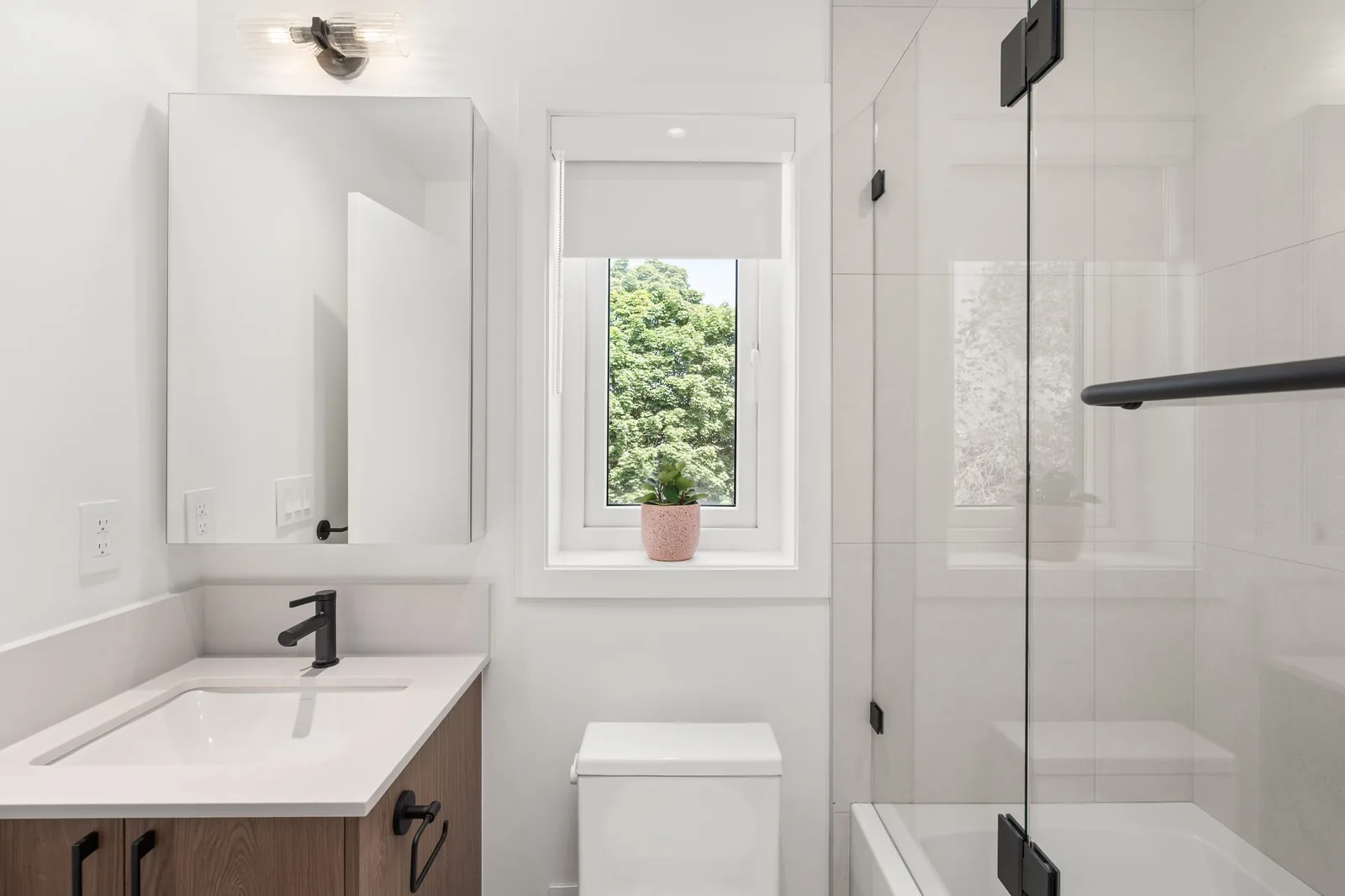
The first year in a new Vancouver multiplex is when the house dries out and settles, and the families learn how it works. Small cracks show up, windows fog on cold mornings, and a filter you never knew about needs cleaning. Most of this is normal. Some of it is a defect that you should report while the first warranty tier is still in force. In this post, we walk you through the year season by season, show what BC Housing says is normal, explain who repairs what between you and your strata, and set out how to report a problem in writing.
We built this list from named sources: BC Housing's Residential Construction Performance Guide and its Maintenance Matters bulletins, the Standard Bylaws in BC's Strata Property Act, BC Hydro's heat pump pages and the Province's fire safety pages. The handover walkthrough itself is covered in our post on checking your finishes at handover. This post starts the day after you get the keys.
New concrete, wood and drywall hold water from the build, and they give it up during the first heating season. As they dry, they shrink, and the house moves with them. The Performance Guide says weathering, normal wear and tear, and "normal shrinkage of materials such as concrete and wood" are not covered by home warranty insurance (Warranty Requirements, page 6).
Three things you will likely see, and how the guide treats each one:
- Fine cracks in a concrete floor. The guide says cracks from normal shrinkage and minor settlement are "not uncommon" and not covered. A crack wider than 6 mm, or with one side more than 6 mm higher than the other, is excessive and must be repaired (section 1.5, page 22). Its tip: keep deep-rooted plants, shrubs and trees away from the foundation, because roots can block the drain tile and crack concrete.
- Gaps between hardwood boards. A gap that stays open more than 1.5 mm along the length of a board is not acceptable, but gaps from normal shrinkage as the wood dries after construction are not covered (section 12.20, page 241). Our post on finishes that last covers wood floors in more detail.
- Water on the inside of the windows. The guide says condensation on interior window surfaces is common in the cold months, and lists no warranty coverage for it (section 8.4, page 153). BC Housing's Maintenance Matters No. 3 explains why a new home shows more of it at first: moisture in plaster, cement and other materials escapes into the air during the first heating season. The bulletin says this should go down after a month or two, and that if it does not, you should tell your building or maintenance manager.
Drywall cracks and nail pops follow the same pattern, and the guide lets the builder repair the ones that qualify toward the end of the first year. Our handover post lists those limits.
When a Vancouver multiplex is sold as separate homes under a strata plan, each family owns its strata lot, and all the owners together own the common property through the strata corporation. Section 72 of the Act says the strata corporation must repair and maintain common property and common assets. The Standard Bylaws at the end of the Act set out the split in more detail, unless your strata filed its own bylaws.
Bylaw 2: the owner. You repair and maintain your own strata lot, except the parts the bylaws give to the strata. If you have the use of limited common property, such as a private yard or a patio set aside for your home, you repair and maintain that too, with the same exception.
Bylaw 8: the strata. The strata corporation repairs and maintains the common assets and the common property. On your own strata lot, its duty covers five things: the structure of the building, the exterior of the building, chimneys, stairs, balconies and other things attached to the exterior, exterior doors, windows and skylights, and the fences and railings around patios, balconies and yards. On limited common property, the strata also takes the work that usually happens less often than once a year.
For a family in a multiplex, that means:
- The roof, the siding, the gutters on the outside walls and the exterior caulking belong to the strata's list.
- The heat pump filters, the ventilator filters, the dishwasher hose, the shower grout and the smoke alarms inside your home belong to yours.
- The lawn in your own fenced yard is yours to mow. The fence around it is the strata's.
Under bylaw 5, you also need the strata's written approval before you change any of the bylaw 8 items on your lot, such as adding a window or swapping an exterior door. Our post on strata life in a small multiplex covers the first meeting, the reserve fund and the property manager.
The Performance Guide says that in a strata, home warranty insurance gives separate coverage for each unit and for the common property. The strata board deals with warranty claims for defects in the common property, and each owner deals with claims for their own unit (Warranty Requirements, page 6).
The dates differ too. The first tier covers defects in materials and labour for 12 months in a unit and 15 months on common property. The common property coverage starts on the first commencement date of any unit in the building (pages 7 to 9), so the guide warns that its expiry dates come earlier than for most of the units (page 11). Section 15 of the Homeowner Protection Act Regulation says the warranty provider must give each owner a schedule of expiry dates, and in a strata it must include the common property dates. Put both sets of dates in your calendar on the day the schedule arrives. Our post on the BC home warranty explains all three tiers.
BC Housing's maintenance page says you could limit your warranty coverage through negligent or improper maintenance. Section 14 of the Regulation limits that rule to the maintenance steps the builder or warranty provider gave the original owner. In plain words, the manual you receive at handover sets out the maintenance your warranty provider can expect from you. The Performance Guide repeats this on many items, including gutters, exterior caulking and wood floors.
Keep the manual where every adult in the home can find it. In a multiplex with grandparents on the ground floor and a young family above, more than one person may need to know where the water shut-off is.
You can move in at any time of year, so start from the season you are in and work forward.
- Find the Water Shut-Offs. BC Housing's Maintenance Matters No. 21 says to identify the main water shut-off before a leak happens. In a multi-unit building it may be in a utility closet or a hallway ceiling, so ask your strata representative. Most fixtures and appliances also have their own shut-off at the connection.
- Test Every Alarm. The Province's smoke alarm toolkit says to test all smoke alarms at least once a month with the test button. Its carbon monoxide page says the same for carbon monoxide (CO) alarms. Pick one day each month and test them all.
- Learn the Ventilation System. Maintenance Matters No. 16 says the heat recovery ventilator (the box that brings in fresh outdoor air and warms it with the stale air going out) is meant to run all the time, and that shutting it off for long periods lets pollutants and humidity build up. Ask for a hands-on demonstration at handover.
- Buy a Hygrometer. It is a small meter that reads indoor humidity. You will use it all winter.
Our post on building through the wet season gives Vancouver's monthly rainfall figures. Do this list before the wettest months arrive.
- Clean the Gutters and Downspouts. The Performance Guide calls this "a regular maintenance item" that, left alone, can cause leaks and clogged drains. Its tip is to check the joints in the gutters for water tightness before winter, and to keep overhanging branches trimmed away (sections 5.18 and 5.19, pages 123 and 124). Gutters that overflow because leaves or other debris block them are not covered by warranty. In a strata, ask your council or manager who books this work.
- Have the Roof Inspected. Maintenance Matters No. 2 says roofs should be inspected twice a year: in the spring for winter damage, and in the fall to prepare for winter rain. It also asks for an inspection after any storm with high winds. The bulletin says this work needs a professional roofer, for the training and safety it involves.
- Shut Off the Outdoor Taps. Maintenance Matters No. 21 says to close the shut-off valve for each outdoor faucet in winter, leave the faucet open so the line drains, and insulate exterior pipes.
- Check the Heat Pump's Outdoor Unit. BC Hydro's heat pump tips say to check the outdoor unit at the start of every season and clear away dirt, debris, snow, ice and dripping water so air can move freely.
This is when a new home dries out, and when condensation shows up.
- Keep Humidity in Range. Maintenance Matters No. 3 gives 18 to 24 degrees Celsius and 35 to 60 percent relative humidity as a general guide for coastal BC in winter. The Performance Guide's appendix on wood floors gives 30 to 50 percent (Appendix A2, page 323). If you have wood floors, 35 to 50 percent sits inside both ranges.
- Lower the Moisture You Make. The bulletin says a family of four can add the equivalent of 30 to 40 litres of water to the air each week, citing Natural Resources Canada. Its steps: dry clothes in a dryer vented outside, put lids on pots, run the range hood while you cook, and run the bathroom fan while you shower and for a while after.
- Let the Air Move. Open blinds and drapes so air reaches the windows, and keep sofas and bookcases off the outside walls. If your home has a preset main exhaust fan, the bulletin says to set it to run for two 4-hour periods a day.
- Use the Fans to Clear Window Condensation. The bulletin says that leaving a window partly open as a fix for window condensation is not recommended, because it can cause condensation and damage inside the walls where you cannot see it, and it uses more energy for heating. Run the fans and the ventilator instead.
- Report What Does Not Go Away. The bulletin lists the signs of a persistent problem: windows that keep fogging or icing after you have lowered the humidity, black staining in wall corners, mould, and damp basement walls or floors. Report these to your maintenance manager, and in writing to the warranty provider and builder if you think the cause is a defect.
Maintenance Matters No. 16 gives seven steps for the heat recovery ventilator, every three months:
- Turn it off and unplug it.
- Clean or replace the air filters. Most new units have filters you vacuum and then wash with mild soap and water.
- Clear leaves and other blockages from the outdoor intake and exhaust hoods.
- Pour warm, clean water into each drain pan to check that the condensate drain flows freely.
- Clean the heat exchange core as your owner's manual says.
- Once a year, remove the grilles and vacuum inside the duct ends.
- Brush dirt off the fan blades.
Heat pumps have their own filters. BC Hydro's heat pump page says filters on indoor units should generally be cleaned several times a year and replaced once a year, and that your heat pump's user guide sets the schedule for your model. Quintet, the five-home multiplex at 2240 E 40th Ave on Costar's project gallery, lists a heat pump in every home on its project page, from the developer's sales package. Our post on heat pumps in Vancouver explains how they work.
- Roof Inspection Number Two. Maintenance Matters No. 2 puts the second yearly inspection in the spring, to find any winter damage.
- Walk the Exterior Caulking. The Performance Guide says caulking and sealants break down under normal weather and should be checked and maintained regularly (section 4.37, page 102). Maintenance Matters No. 5 says sealants should be reviewed every year, and lists the signs of failure: sealant pulling away from the surface, cracks or splits within it, lost flexibility, and blistering, chalking or discolouring. It also says the repair is a job for a professional. In a strata, report what you see to the council, because bylaw 8 puts the exterior on the strata's side.
- Keep Soil Off the Siding. The Performance Guide's tip is not to put soil or flower beds against the cladding (section 4.37, page 102). Plan your new garden with that in mind.
- Seal the Shower Grout. The Performance Guide suggests a clear liquid silicone sealer on tiled tub and shower grout at least every six months (section 9.16, page 185). Do it in the fall and again in the spring or summer.
- Check Every Water Connection. Maintenance Matters No. 21 asks for a yearly look at every water system: turn each shut-off valve off and on so it does not seize, check that showers, tubs and toilets are sealed, and look at appliance hoses for cracks, corrosion and mineral buildup. Shut off the washing machine's water supply before you leave on vacation.
- Book Heat Pump Service. BC Hydro suggests professional maintenance every one to two years, in the opposite season from the last visit where possible.
- Replace 9 Volt Batteries. The Province's toolkit says to replace 9 volt smoke alarm batteries at least once a year, or as the maker recommends. Write the date on the alarm.
The 12-month tier for your unit and the 15-month tier for the common property cover any defect in materials and labour. After those dates, the Regulation's coverage narrows to the 24-month tier for the home's systems, cladding, caulking, windows and doors, and then to the 5-year envelope and 10-year structure tiers. Walk your home with the list you have kept all year: the drywall cracks, the sticking door, the gap in the floor. Compare each one with the Performance Guide's limits, and send in anything that qualifies before the date on your expiry schedule. The strata council should do the same walk for the shared parts before the 15-month date.
Section 16 of the Regulation says you must give written notice in reasonable detail to both the warranty provider and the builder, within a reasonable time after you find the defect and before that coverage ends. The Performance Guide puts it simply: say what the problem is, in simple terms, and where in the home it is (pages 10 and 11).
The guide adds these points:
- A phone call should be followed quickly by written notice. Notice sent long after the problem, or after the repair is done, may affect the claim.
- If water is coming in, you must take reasonable steps to limit the damage. Take photos before and during any emergency repair.
- The warranty provider may ask for your warranty number and copies of your letters with the builder. Keep them together.
- You must let the warranty provider and the builder in to inspect and repair at reasonable times, with reasonable notice.
- "Whenever there is doubt, it is advisable to send written notice."
For common property, the strata corporation is the owner who sends the notice. In a small multiplex, agree at the first council meeting who writes those letters and where the copies are kept.
Make One Calendar for the Building. Put the alarm test day, the filter days, the gutter and roof dates, and both warranty expiry schedules in one shared calendar for all the owners.
Keep a Defect Log. One page per item: the date you found it, a photo with a tape measure beside it, and the date you sent notice.
Read Your Bylaws Once. Check whether your strata uses the Standard Bylaws or its own. That answers most "who pays" questions before they start.
Ask Before You Change the Outside. A new exterior door, a window, a deck gate or a fence change needs the strata's written approval under bylaw 5.
Clean Before You Report. If a fan, a ventilator or a gutter is not working, check the filter or the debris first. If cleaning does not fix it, report it in writing.
In the REW video about our We Killarney six-plex, Louis Nguyen, Costar's Director of Sales, says we choose materials that are easy to maintain and hide imperfections well, because the homes are built for small children, young families and elders.
After handover, Costar's process page describes a fifth stage: return inspections at 3, 6 and 12 months to check that the home's inside and outside systems work, with needed fixes addressed within a few days. That is Costar's own account of its process. The 12-month visit falls near the end of the first 12-month warranty tier for each unit. Ask your Costar consultant to confirm in writing which warranty programme and terms apply to your project before you sign.
If you are planning a multiplex in Vancouver and want to talk about how the homes will be cared for after the families move in, our team would be glad to walk you through it. Tell us about your project today.
Related on this site: Multiplex construction in Vancouver · Quintet Townhomes, a five-home multiplex in Vancouver · Our five-stage process · Book a one-hour project consultation